


Pin Code/Postal Codes of India
India uses a system called the PIN Code (Postal Index Number) to identify specific geographic delivery areas for mail and courier services. The PIN system was introduced by Shriram Bhikaji on 15 August 1972 to simplify and speed up the sorting and delivery of letters, parcels, and official documents across the country.
The Postal Index Number (PIN) Code system in India is a six-digit numbering system. The first digit indicates one of the major postal regions of India, the second digit identifies the sub-region, and the third digit represents the sorting district. The final three digits refer to the individual post office serving that area.
What is PIN (Postal Index Number)?
PIN code stands for Postal Index Number code. The aim of introducing the PIN code system in the country was to help the postal department in sorting and delivering mail manually to the accurate address. It also helps to eliminate confusion over similar place names, different languages, and incorrect addresses used by people.
Structure and Postal Zones of India PIN Codes
India’s PIN Code system is divided into different postal zones to make mail delivery faster and more organized across the country. The first digit of every PIN Code represents a particular postal zone, while the remaining digits help identify the sorting district, service route, and delivery post office. Here is the detailed explanation:
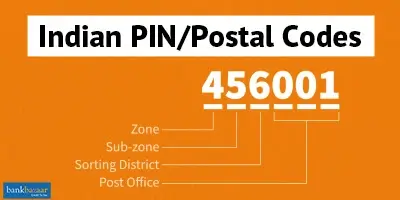
Postal Zones in India:
There are nine postal zones in the country of which eight are regional and one is used for the Indian Army. The first digit of the PIN code designates the zone and is used across the nine zones which are spread across India. Now, let us have a look at the table given below:
PIN Code Digits | Zone |
1 | Chandigarh, Himachal Pradesh, Jammu & Kashmir, Haryana, Punjab, Delhi |
2 | Uttar Pradesh, Uttarakhand |
3 | Dadra & Nagar Haveli, Daman & Diu, Rajasthan, |
4 | Chhattisgarh, Madhya Pradesh, Maharashtra, Goa |
5 | Telangana, Andhra Pradesh, Karnataka |
6 | Puducherry, Lakshadweep, Tamil Nadu, Kerala |
7 | Andaman & Nicobar Islands, Sikkim, Assam, Meghalaya, Mizoram, Tripura, Manipur, Arunachal Pradesh, Nagaland, West Bengal, Odisha |
8 | Bihar, Jharkhand |
9 | Field Post Office (FPO), Army Post Office (APO) |
Sorting Districts:
The third digit of the Postal Code Number along with the first two digits represents the particular geographical except the functional zone and this is known as a sorting district which is headquartered at the main post office of the largest city in the region. Every state has one or more sorting districts that are based on the volume of mail handled in a region.
PIN Prefix | Region | ISO 3166-2:IN |
11 | Delhi | DL |
12 -13 | Haryana | HR |
14 - 15 | Punjab | PB |
16 | Chandigarh | CH |
17 | Himachal Pradesh | HP |
18 - 19 | Jammu & Kashmir | JK |
20 - 28 | Uttar Pradesh, Uttarakhand | UP, UK |
30 - 34 | Rajasthan | RT |
396210 | Daman & Diu | DD |
396 | Dadra & Nagar Haveli | DN |
36 - 39 | Gujarat | GJ |
403 | Goa | GA |
40 - 44 | Maharashtra | MH |
45 - 48 | Madhya Pradesh | MP |
49 | Chhattisgarh | CT |
50 | Telangana | TG |
51 - 53 | Andhra Pradesh | AP |
56 - 59 | Karnataka | KA |
605 | Puducherry | PY |
60 - 66 | Tamil Nadu | TN |
682 | Lakshadweep | LD |
67 - 69 | Kerala | KL |
737 | Sikkim | SK |
744 | Andaman & Nicobar Islands | AN |
70 - 74 | West Bengal | WB |
75 - 77 | Odisha | OR |
78 | Assam | AS |
790 - 792 | Arunachal Pradesh | AR |
793 - 794 | Meghalaya | ML |
795 | Manipur | MN |
796 | Mizoram | MZ |
797 - 798 | Nagaland | NL |
799 | Tripura | TR |
80 - 85 | Jharkhand - Bihar | JH, BR |
90 - 99 | Army Postal Service | APS |
Service Route
In the sorting district, the fourth digit indicates the route on which a delivery office is situated. For offices in the sorting district's core area, this value is 0.
Delivery Office
The last two digits indicate the delivery office within the sorting district starting from 01 which would be the Head Office (HO) and the General Post Office (GPO). The delivery offices are numbered sequentially, with higher numbers allotted to newer delivery offices. A new delivery office is created and the next available PIN is assigned if the volume of mail handled at a delivery office becomes too large. Thus, two delivery offices located next to two each other will have the first four common digits.
How to Find PIN Code of your Location?
By following the steps given below, you can find PIN Code of your location easily:
Step 1: Open the search browser and type “find my pin code”.
Step 2: Click on the first website named as find pin code-India post.
Step 3: Click on the option ‘Locate Post Office’.
Step 4: Select the option ‘By State and District’ or by ‘Office Name’.
Step 5: Enter your State/Union Territory and City/District or enter the name of your Post Office.
Step 6: Fill in the captcha code and click on ‘Search’.
Step 7: A list will be shown of all pin codes of that location.
Types of Post Services in India
The following are the various types of post services in India:
Mail Services
India Post offers mail facilities and helps the Indian citizens in sending mail from one place to another. This facility includes insurance of mails, sending mails, and registering mails as security proof.
Allied Postal Services
The postal department of India has the following Allied Postal Services:
- Aadhar Card: India Post provides Aadhar cards to the citizens of India. The staff of the postal department are provided training to verify the details provided by Aadhar applicants. Once the details of the applicants are verified, the biometric details are captured which include fingerprint scanning and iris scan. The gathered information, along with the application form, would be transmitted to UIDAI, which will issue the individuals with Aadhaar cards.
- Passport Facilities: Indian citizens can avail of their passports as India Posts have collaborated with the Ministry of External Affairs. Indian citizens who are willing to apply for a passport can fill up the passport forms and submit them to the nearest post offices for further processing.
- International Money Transfer: People can receive remittances from other nations to India because India Post has collaborated with Western Union Banks.
- Direct Post: Both addressed and unaddressed direct posts can be used to advertise directly.
- e-Bill Post: People can pay their utility bills through the help of e-bill postal services provided by the postal department.
- Media Post: Most of the companies endorse their products using envelopes, postcards, and others through media posts.
- Speed Post: People can send mails to others in a short time as compared to normal posts through speed post services.
- Greeting Post: Greeting post is sent to the beloved ones on special occasions like anniversary or birthday.
Financial Services
The postal department of India offers various financial services to the public such as Public Provident Fund (PPF), Kisan Vikas Patra (KSV), National Savings Certificates (NSC), etc. Apart from this, it also offers several conventional schemes that perform similar functions to that of Indian banking institutions such as money order facilities, fixed deposit accounts, etc. The biggest difference between both of these is the rate of interest. The fixed deposit facility of Indian post offices provides higher interest rates as compared to fixed deposits offered by banks.
About Indian Postal System:
The Postal Department of India is run by the Government of India. This postal system is known as the Post Office of India which comes under the Ministry of Communications and Information Technology of the Government of India. India is divided into 22 postal circles and each postal circle is handled by Chief Postmaster General.
Furthermore, each of these postal circles is divided into regions that will be overseen by a Postmaster General, and the regions will be further into divisions, which will be further subdivided into subdivisions.
For a few years, the Postal Department of India has witnessed rapid change and has emerged as the fastest service provider in the country. It penetrates the most remote places of the country and helps people in sending mail at a very minimal price. Apart from mail services, India Post has established itself as one of the nation's small financial institutions, assisting citizens in safely storing their funds.
Also, Read Articles on Pin Code
FAQs on Pin Code
1.What is a six-digit PIN code?
The six-digit PIN code indicates regions such as zone, sub-zone, state, and district.
2.How do I find my PIN code?
You can find your PIN code by visiting the official website of India Post-Department of Posts.
3.How do you write a PIN code?
The first digit represents the region in India. The second digit is the sub-region, while the third digit is the sorting district. The last three digits represent the particular post office within the district.
4.Is the PIN code and zip code the same?
Yes. PIN code and zip code are the same.
5.What do the last three digits of a PIN code represent?
The last three digits represent the particular post office within the district.
6.What is the full form of PIN?
PIN represents Postal Index Number.
7.How many digits does a Zip Code have?
There are six digits in a Zip Code.
8.What is the zip code of India?
India has separate zip codes for different states.
9.Do international packages go through customs?
Yes. International packages go through customs.

Kankana Mukherjee is an engineer and has over 4.5 of experience in content writing. Combining the expertise in financial content writing achieved in her 2 years association with BankBazaar, and a knack for clear and engaging content, Kankana simplifies complex financial concepts and offers practical insights to help readers make informed decisions and achieve financial success.

Disclaimer
Credit Card:
Credit Score:
Personal Loan:
Home Loan:
Fixed Deposit:


Copyright © 2026 BankBazaar.com.